One of the first things I needed for my capstone project was a schedule. My capstone project, which you can read more about here and here, involves staying up late into the night (if the weather is clear) to take images of a field of stars. For the first part of my project, I was observing a specific star at specific times, and I knew that on some nights I wouldn’t be able to observe that star at the time I needed to be taking images of it.
So, I made a small tool in Python, which plotted the altitude of the target star in the sky over the course of a night, when I would need to be observing the star, and when it would be dark enough to observe. After creating this tool, I made it more general– it now works with any target star, any location, and any constraints on altitude.
Below is an example of one of the figures I used to plan my observations of my first target:
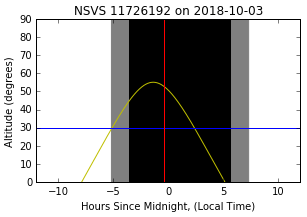
For my research, the red lines corresponded to when the star would reach maximum brightness– this happens periodically about every .6 days, meaning that not every night contained a red line which would be observable. Using a series of these figures, it was easy to check at-a-glance whether I should be trying to observe on a particular night.
After updating the code and adding new features (like creating a text file with the times of all red lines and whether or not they are observable), I am now working to make this tool public. I think that for students, particularly, a basic tool like this is extremely useful for planning observations of periodically varying objects– by making the code public, future students can use it to have an easier time planning out when they should be observing their target star.
 Kain McCall
One thought on “Planning Observations of Variable Stars”